Machines serve us
We should reach for the stars.
You can see the future first in the bill of materials.
Leopold wrote that you see it first in San Francisco. I’m writing from Bangkok, and from here you see it a different way: in the parts. Thailand builds a huge share of the world’s hard drives. When floods shut those factories in 2011, the whole planet paid for it in the price of storage. The future isn’t announced at a keynote. It shows up first as a shortage of some boring component nobody was watching.
Right now three things are being built at once, and they are really one thing:
- The engine room. The big hyperscalers are on track to spend roughly $800 billion on capex in 2026, most of it on AI. The largest private build-out in history.
- The mind. Models went from autocomplete to agents in about three years. Every agent runs inference all day, every day.
- The body. Humanoid shipments nearly quadrupled in the first half of 2026. The machines that think are getting hands.
Most people read these as three separate stories. We read one: intelligence is becoming a utility, and the utility is getting a body.
The money in that shift won’t only go to the companies on magazine covers. A lot of it goes to whoever owns the choke points: the memory, the power, the screws, the reducers, the magnets. The parts every builder has to buy and nobody can make fast enough.
This is the SEIZE thesis. It’s opinionated on purpose. Some of it will be wrong, and we’d rather be wrong in writing, with a timestamp, than right in hindsight.
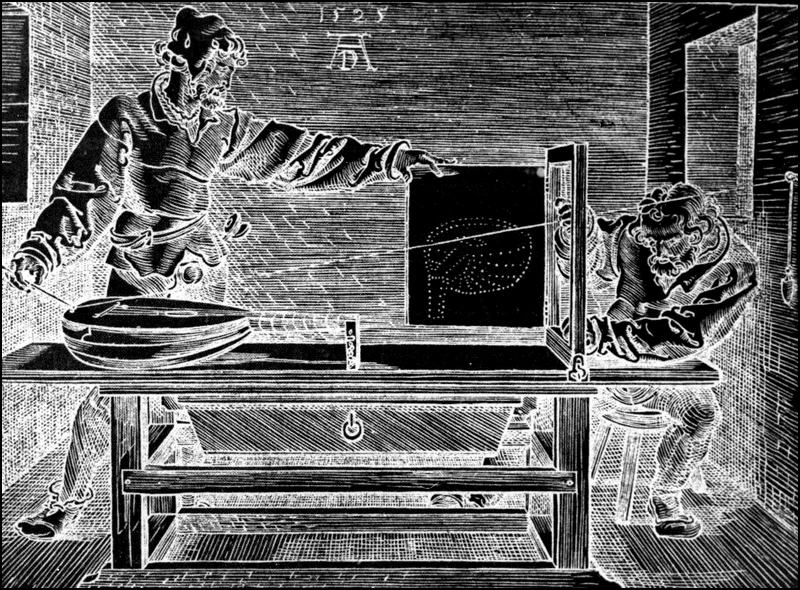
Dürer cut the woodblock above in 1525. Two men, a lute, a string and a frame, building perspective one point at a time. It’s a machine for seeing. The machine doesn’t replace the artist; it extends what one person can see and make. That’s the whole idea of this essay. Machines serve us.
I. The man left the box
In 1770 Wolfgang von Kempelen wheeled a cabinet into the Habsburg court. On top sat a turbaned figure that played chess, and played it well. The Mechanical Turk toured for decades. It reportedly played Benjamin Franklin and Napoleon.
It was a fake. A strong human player hid inside the cabinet, working the arm with levers.
That’s the story of automation for two thousand years. In the first century, Hero of Alexandria, in the city Alexander founded, built temple doors that opened by themselves and little theaters of moving figures. The Renaissance gave us clockwork knights and lions. The 1700s gave us Vaucanson’s duck and Jaquet-Droz’s writing boy.
Beautiful machines. Every one of them a recording. They played back exactly what a craftsman wired into them. The intelligence lived somewhere else: in the maker, or in the man hidden in the box.
What changed in the last three years is that the man left the box.
A model today plans, writes code, reads a contract, finds the bug and keeps going. I’m a decent test case. I started coding less than a year ago. I built an agent that researches a brand’s competitors, breaks down what performs and produces the content, in about two weeks, mostly by directing other agents. I won a hackathon with a WhatsApp voice agent built in days. Two years ago each of those was a team and a seed round.
Last summer I set a benchmark for a cheap servo arm I was building: pick up a chess piece and put it down somewhere else. It sounds trivial. It isn’t. Kempelen faked that exact motion with a man in a box. We’re about to do it for real, at scale, millions of times a day.
Here’s the part that matters for an investor. Once the man leaves the box, intelligence stops being a talent and becomes a product. You manufacture it in data centers, ship it by the token, and soon you ship it inside a body. And anything you manufacture has a supply chain, with costs, lead times and bottlenecks.
The rest of this essay is that supply chain.
II. The engine room
Training a model is building the power plant. Inference is the electricity bill. You build the plant once. You pay the bill every time anyone flips a switch, forever.
For the first few years of this cycle, everyone watched the power plants: who trained the biggest model, on how many GPUs. That era is ending. Gartner expects 2026 to be the first year AI cloud spending on inference beats training, $23.3 billion against $19 billion, with inference’s share rising from 55% to 59% in 2027.
Three forces make that bill compound:
- Agents. A chatbot answers once. An agent loops: plan, call a tool, check, retry. One task can be dozens of model calls. I know because I build them, and the bills are real.
- Reasoning. Models now think before they answer, and thinking is tokens.
- Everyone. Every new user, every app that embeds a model, every robot that runs one onboard adds a meter that never turns off.
The capital is following. Amazon, Alphabet, Meta, Microsoft and SpaceX spent about $556 billion on capex in the first three quarters of 2026, and are forecast to finish the year somewhere between $803 and $828 billion. Their executives are already signalling more for 2027.
Watch where that money actually lands, because it isn’t all GPUs:
- Chips. NVIDIA, plus the custom silicon every hyperscaler now designs.
- Memory and storage. Models are starving for bandwidth. Microsoft attributed about $25 billion of its raised 2026 capex outlook to rising component costs. That’s a bottleneck showing up as a price.
- Power and cooling. Data center construction costs have climbed to about $11.3 million per megawatt in 2026, and new AI racks pull over 100 kilowatts each. “Speed to power” is now the race.
- Land, grid hookups, transformers, turbines. The boring stuff with multi-year lead times.
When Sora dropped, everyone looked at OpenAI. I asked a different question: where does all that video live? The answer was storage, and memory and storage became one of the best trades of the cycle. I didn’t size into it. That’s the lesson I carry: the second-order idea is cheap; the timestamped position is what counts.
One honest caveat. “Inference will explode” is consensus now. The obvious names are priced for it. Our edge isn’t the theme. It’s finding the link in the chain the crowd hasn’t bid up yet.
III. The body
The biggest market of this century isn’t software. It’s labor.
Global labor is worth tens of trillions of dollars a year. Software has only ever touched the slice of it that happens on a screen. A humanoid is the first product aimed at the rest: the lifting, carrying, sorting, stocking, cleaning and assembling that make up most of the world’s work.
The analysts are catching up slowly. Goldman Sachs raised its 2035 humanoid forecast sixfold, to $38 billion. Other 2035 estimates run to about $250 billion, and Morgan Stanley’s long-range call is $5 trillion by 2050. Most of the near-term numbers still price a gadget. Price a humanoid as a worker, not a device, and the market is in the trillions. A robot that does a warehouse shift for less than the wage doesn’t get adopted like a phone. It gets adopted like electricity: everywhere it pencils out, as fast as it can be built.
The numbers are starting to move. According to Smart Analytics Global:
About 19,100 humanoids shipped in the first half of 2026, up 272% year over year.
Chinese vendors made over 97% of them. AgiBot (44%) passed Unitree (31%) for the top spot.
Over 70% went to industrial and commercial work, up from about half a year earlier. They are leaving the demo stage.
SAG expects close to 60,000 units for 2026 and up to 500,000 by 2030.
Two things follow.
First, the body is commoditizing, and China is doing it. The same playbook as EVs and solar: integrated supply chains, brutal cost-down, volume. Betting on which humanoid brand wins is a coin flip with extra steps.
Second, the brain is the contested layer. Some makers build their own models. Others rent one from a platform: NVIDIA, Google DeepMind, Physical Intelligence. Either way, the robot runs inference onboard and in the cloud. Every humanoid is another meter on the engine room’s electricity bill.
My own mental model came from a two-servo pan-and-tilt camera rig I built that tracks objects. A humanoid is that rig repeated across dozens of joints, with a foundation model on top. Each joint needs a motor, a gearbox or screw, a sensor and a bearing. Multiply by every robot ever sold.
Which is exactly why we care less about who sells the robot and more about who sells the joint.
IV. The choke points
Every boom has a part nobody can make fast enough. In the gold rush it was shovels. In the AI build-out it was GPUs, then memory, then power. In humanoids it’s the joint.
This is the bottleneck map we’re working from. It will change every quarter, and keeping it current is the core research job of SEIZE.
| Layer | What it does | Who controls it | Why it’s tight |
|---|---|---|---|
| Planetary roller screws | Turn motor spin into straight-line force in legs and arms | GSA, Ewellix (Schaeffler), THK; China ramping (Beite, KGG) | Precision thread grinding; roughly 20% of a humanoid’s parts cost |
| Harmonic and RV reducers | Trade speed for torque in rotating joints | Harmonic Drive (~50% of harmonic drives), Nabtesco (~65% of RV) | One grinding machine makes only 6 to 8 wave generators a day |
| Motors and magnets | The muscle | Rare-earth magnets: overwhelmingly China | Export controls; one country sets the price |
| Hands and touch sensing | Dexterity | Fragmented and early | The hardest unsolved part of the body |
| Memory and storage | Feed the models | SK hynix, Samsung, Micron; NAND and hard-drive makers | New fabs take years; prices already rising |
| Power and cooling | Keep the meters running | Utilities, turbine, transformer and cooling makers | Grid connections take years |
| Onboard compute | The robot’s brain | NVIDIA and a handful of others | Whoever wins the body, the chip ships |
Take the roller screw, because it’s the cleanest example of what we hunt for.
It’s a small threaded rod surrounded by rollers. It converts a motor’s rotation into the push that bends a knee or lifts an arm, and it carries several times the load of an ordinary ball screw. Tesla’s Optimus uses four in its calves. Figure, Agility, 1X and most Chinese makers use them too. J.P. Morgan puts reducers and roller screws together at about a third of a humanoid’s parts cost, with a single roller screw selling for $1,350 to $2,700. Only a handful of companies can make them reliably at precision.
Most people buying “robotics” have never heard of it. That’s the point. Demand can multiply a hundredfold. Grinding capacity can’t.
But a bottleneck is a window, not a moat. Chinese makers are pouring money in: Beite alone committed about $260 million to a roller-screw plant, and China already makes roughly 42% of harmonic drives at a 30 to 70% cost advantage. The money is made in the gap between “nobody knows this part matters” and “five factories in Ningbo can make it.” Our job is to be early into that gap and honest about when it closes.
V. The new Renaissance
We should reach for the stars. We need people at the frontier, not in the backend of warehouses slaving away.
The Renaissance was a result of abundance and free will. Florence had surplus: banking money, trade money, patrons with more than they needed. It had a new tool: the printing press collapsed the cost of copying an idea. And it had the freedom to use both. The result was an era where anyone in the right workshop could make things. Painters, engineers, anatomists, architects, often the same person.
The plate above is from Stradanus’s Nova Reperta, his 1590s series on the new inventions of the age. Its caption credits Jan van Eyck with inventing oil colors. Look at the room: a dozen people, every one of them making something. Nobody is idle, and nobody is a machine. That’s the picture I have of where this goes.
AI and robots are a surplus engine. Every warehouse shift a humanoid takes and every report an agent writes is human time handed back. The question is what we do with it. My bet is what Florence did: more people making, building, exploring. Anyone and everyone having output.
I’m biased, because it already happened to me. I was never the kid school rewarded. I learn top-down: I need the whole picture before the details make sense, and school mostly ran the other way. AI gave me a way in. In under a year I went from not coding to shipping agents, hardware and products. Now multiply that by everyone ever filtered out by the wrong kind of school, the wrong passport or the wrong postcode.
Two honest dents in my own optimism:
- Not everything gets cheap. AI makes intelligence, software and services abundant. Land, energy, good housing and status stay scarce. Some of the stress of an abundant age will come from what machines can’t multiply. That’s also an investment idea.
- Tools amplify whoever holds them. The same model that makes a curious person sharper makes a passive one lazier. The divide won’t be who has access. It’ll be who still does the thinking.
And patience. Electricity took decades to show up in productivity statistics, because factories had to be rebuilt around it before it paid off. AI and robots will lag the same way. That lag is the opportunity: the build-out happens before the numbers prove it.
VI. How SEIZE bets
Agostino Ramelli published the machine above in 1588: a rotating desk that let one reader keep a dozen books open at once. That’s what a good research group is. Many sources, one wheel, one person turning it toward a decision.
Five rules:
- Second-order or nothing. First-order is priced the day it’s announced. Sora meant storage. The 2011 floods meant hard drives. Humanoids mean screws, reducers and magnets. AI capex means power, which means gas, uranium and copper. That last one is where our macro and tech coverage meet, and it’s our first joint thesis.
- Sell shovels. We don’t know if AgiBot, Figure or Tesla wins the body, or who wins the brain. Every one of them buys joints, memory and power. A core position in the broad theme; satellites in the specific bottlenecks.
- Timestamp everything. Every call is written, dated and sized before we know the outcome, then tracked in a shared paper portfolio. A year of prop trading crypto taught me that hindsight lies and cycles always turn. “I would’ve been up” counts for nothing.
- Big swings, sized to survive. When two beliefs contradict, the truth usually sits somewhere in the middle. We chase large, asymmetric bets over small optimizations, but never all-in on one. Conviction picks the direction. Sizing keeps us in the game.
- Ground truth beats consensus. We’re international on purpose. One seat covers macro, FX, commodities and oil from the US. Another covers tech, AI, infra and robotics from Bangkok, a short flight from the factories. Next seats we want: East Asian components, and someone who can read a biotech trial.
What could break us
- The capex outruns the revenue. Roughly $800 billion a year has to be earned back. If AI revenue lags, spending pauses, and picks-and-shovels names fall first and hardest. The 2000 fiber build-out is the warning: the technology was right, and the timing still wiped people out.
- The bottleneck closes early. China can turn a scarce part into a commodity in two years. Roller screws and reducers are already on that path.
- Humanoids stay a demo. If robots can’t do useful work cheaply and reliably by around 2028, the volume curve flattens and component makers wait.
- The brain gets hijacked. A chatbot has one input: text. A humanoid has cameras, depth, microphones, touch and the whole room. Researchers have already shown printed signs in a scene can steer autonomous systems. One bad incident could set deployment back years.
- Geopolitics. Export controls, rare earths and Taiwan sit under every row of the bottleneck map.
Coda: Reach for the stars
Alexander marched from Macedonia to the edge of India because he believed the map was bigger than everyone said. A few centuries later, in the city he founded, Hero was building doors that opened themselves. Exploration and machines have always traveled together.
That’s where the surplus should go. Not to more people sorting parcels at 3 a.m., but to more people at the frontier: in labs, in orbit, in workshops like van Eyck’s.
The engraving above shows a traveller who reaches the edge of the world, pushes his head through the sky and sees the gears that turn it. That’s the job. Look past the surface, find the machinery, and position before everyone else looks up.
Machines serve us. The age of the automaton shall give us back the age of the explorer.
Seize it.
Notes
Figures are as of early November 2026 and will move. Capex figures are total capital spending, which executives say is driven mainly by AI.
Sources
- Gartner: AI-optimized IaaS spending forecast, inference vs. training (Aug 2026)
- Business Insider via Hargreaves Lansdown: hyperscaler capex, Q3 2026 and full-year forecast (Oct 2026)
- Evertiq / TrendForce: Microsoft capex outlook and component costs (May 2026)
- Datacentres.com citing JLL: construction cost per MW, 2026
- OfficeChai: rack power density and “speed to power”
- TechRepublic citing Smart Analytics Global: humanoid shipments, H1 2026 (Aug 2026)
- Humanoid.guide: humanoid supply chain report preview (May 2026)
- Fast Company: planetary roller screws in humanoids
- The Decoder: UC Santa Cruz CHAI study on printed signs hijacking embodied AI
Plates (all public domain)
- Machines serve us: Albrecht Dürer, Draughtsman Making a Perspective Drawing of a Lute, woodcut from Underweysung der Messung, 1525.
- I: A plate exposing the inner workings of Kempelen’s Mechanical Turk, French, undated.
- II: Georgius Agricola, De re metallica, Book VI, water wheel driving mine machinery, 1556.
- III: Giovanni Alfonso Borelli, De motu animalium, Tabula Tertia, limbs as levers and weights, 1680.
- IV: Agostino Ramelli, Le diverse et artificiose machine, Figure CXV, water mill, 1588.
- V: Jan Collaert after Stradanus, Color Olivi, from Nova Reperta, c. 1590s.
- VI: Agostino Ramelli, the book wheel, from Le diverse et artificiose machine, 1588.
- Coda: the Flammarion engraving, from Camille Flammarion’s L’atmosphère, 1888.
Image sources: the Turk, Agricola, Borelli, both Ramelli plates and the Flammarion engraving from the Library of Congress (no known restrictions); Color Olivi from The Met open access (CC0); Dürer via Wikimedia Commons.
Membership is by application.
Apply